Anirban DasGupta, Purdue University, investigates a link between fractals and food, specifically fruit and vegetables:
Although the use of the word fractal does not seem to have been made before the 20th century, the ideas of repetitive self-similarity in progressively smaller scales had already emerged at least as early as the 19th century. The standard example graduate students see of an everywhere continuous and yet nowhere differentiable function, constructed by Karl Weierstrass in 1872, is an example of what we would call a fractal. The Weierstrass functions are of the form $W_{b, \alpha}(x) = \sum_{n = 1}^\infty \,\cos (b^n\,x)/b^{n\,\alpha}$, where $b > 1$ is a natural number and $0 < \alpha \leq 1$. The Weierstrass functions are Hölder of order $\alpha $ (when $< 1$), and yet nowhere differentiable. These functions have a very wiggly graph, and the graphs have fractal dimension (Minkowski) $2-\alpha $ (if $\alpha \neq 1$. So the fractal dimension is larger than 1 for Weierstrass functions. Their graphs depict self-similarity when viewed in smaller scales, and are filling up more space than a smooth curve would do, e.g., a line. We now know that the fractal nature of graphs of continuous functions is a rule, rather than an exception. For functions that are continuous on, say, $[0, 1]$, the subclass of functions that have even one point of differentiability is a set of first category, and has Wiener measure zero. Numerous other such functions are now known, although Riemann’s example that was announced before Weierstrass’s is now known to be incorrect; his function is not nowhere differentiable.
Today I am examining the appearance of fractals and fractal dimensions in our food, in particular fruits and vegetables. Cruciferous vegetables are widely advised by nutritionists and physicians, and they are fractals. We can even quantify their fractality by estimating their fractal dimensions (through slicing/chopping experiments). Interestingly, AI provides these estimated fractal dimensions for a large collection of fruits and vegetables. But one has to dig them up one at a time. Here is a list of the fractal dimensions of some of the 39 fruits and vegetables that we looked at; these are all Minkowski dimensions:
Broccoli (cross sections) 1.78; Broccoli head 2.8; White, purple and orange Cauliflower 1.88; Lettuce 1.65; Spinach 1.82; Asparagus 1.76; Bokchoy 1.8; Napa 1.5; Tomato 1.41; Yam 1.88; Walnuts 1.25; Cashews 1.5; Fuji apple 1.32; Mandarin orange 1.25; Banana 1.77; Mango 1.44; Papaya 1.43; Ugli fruit 1.75; Strawberry 1.42; Blackberry 1.38; Custard apple 1.4; Prickly pear 1.66.
By coincidence, the Minkowski dimension of the human cerebral cortex, 2.8, matches the dimension of a broccoli head. On the other hand, 3D Cantor dust has a dimension of $\log _3\,8 = 1.89$, which is close to the dimension of cauliflowers of varied colors. Galaxy clusters are estimated to have a dimension of 2; they appear to be filling less space than a broccoli head does.
We can look at any possible connections between fractal dimensions of fruits and vegetables and their nutritional values, and also to get an idea of how the fractal dimensions are distributed. For example, which fruits and vegetables are high and low quantiles in the fractal scale. Using the well-known Epanechnikov kernel $K(z) = \frac{3}{20\,\sqrt{5}}\,(5-z^2)\,I_{z^2 \leq 5}$, and with the prominent optimal bandwidth formula $h = 1.06\,n^{-1/5}\,\min\,\{s, Q/1.34\}$, where $s$ and $Q$ are the standard deviation and the interquartile range of the $n = 39$ fractal dimension data values, a nonparametric density estimate for the true density of fractal dimensions of fruits and vegetables is plotted below. The estimate is giving some hint of having been under-smoothed; also, the shoulder near 2.0 may not be real. We do not have room for it here, but a confidence band for the true density by using the results on the $\mathcal{L}_\infty $ and the $\mathcal{L}_2$ error of kernel density estimates in Bickel and Rosenblatt (1973) could be of some interest. If we were to take the density estimate literally, there is some evidence of a mixture. A possible source of the mixture nature might be a small fraction of fruits and vegetables with high fractal dimensions—basically the cruciferous and leafy vegetables, and fruit/veg such as the ugli fruit, prickly pear, yams and jackfruit.
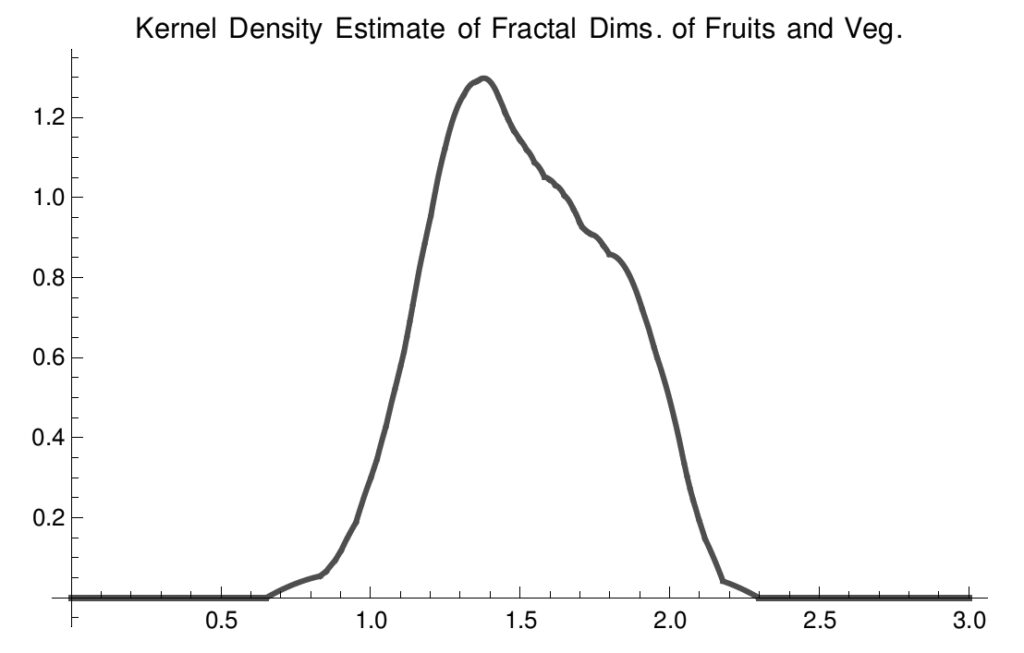
Kernel Density Estimate of Fractal Dimensions of Fruits and Vegetables
Let’s take a quick look at the nutritional profile of some of the fruits and vegetables at the upper tail of the fractal dimension.
| Vitamin A | Vitamin B | Vitamin C | Calcium | Potassium | Iron | Fiber | |
|---|---|---|---|---|---|---|---|
| Broccoli | $\checkmark$ | $\checkmark$ | $\checkmark$ | $\checkmark$ | $\checkmark$ | ||
| Cauliflower | $\checkmark$ | $\checkmark$ | $\checkmark$ | ||||
| Spinach | $\checkmark$ | $\checkmark$ | $\checkmark$ | $\checkmark$ | $\checkmark$ | $\checkmark$ | |
| Ugli fruit | $\checkmark$ | $\checkmark$ | $\checkmark$ | $\checkmark$ | $\checkmark$ |
To the dismay of children everywhere, broccoli looks like a nutritional champion, and has, perhaps curiously, a high fractal dimension. So do the others in our little table. Perhaps you could emulate President George H. W. Bush, and say, “I am President, and I will NOT eat broccoli.”