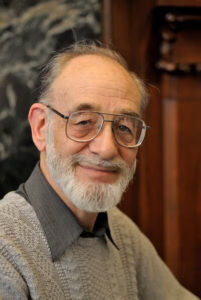
Stephen Portnoy
On December 28, 2025 our distinguished friend and colleague Stephen Portnoy passed away at the age of 83. Stephen was a founding member of the Department of Statistics at the University of Illinois at Urbana-Champaign and an influential contributor to the international research community of mathematical statistics throughout his long career. He was a Fellow of the IMS and the ASA and recipient of the prestigious International Franqui Professorship at the Université Libre de Bruxelles in 2005.
Stephen Portnoy was born in Kankakee, Illinois, in 1942, attended high school in Menlo Park, California, earned an undergraduate degree in mathematics at MIT, and a PhD in Statistics at Stanford in 1969 under Charles Stein. Until 1974 he was an Assistant Professor at Harvard University. He joined the math department at UIUC in 1974 and following the formation of the Statistics Department became Professor of Statistics until his retirement in 2002. After moving to Oregon in 2016, he became Adjunct Professor of Statistics at Portland State University. Steve remained active in research even after his retirement. He co-edited the flagship journal of the ASA, the Journal of the American Statistical Association (Theory & Methods), from 2005–08. His most recent publication appeared in 2022 on canonical quantile regression.
Following the lead of Stein, Steve’s early work focused on decision theory and admissibility. However, his 1977 paper on “robustness in dependent situations” marked a shift toward the emerging field of robust statistics and provided a new rationale for redescending M-estimators. In the 1980s he began a series of fundamental papers on “large-p” asymptotics that anticipated the contemporary profusion of work on high-dimensional statistics. These papers established conditions under which regression estimators with p parameters and n observations would be consistent and asymptotically Gaussian when p2∕n was large. Toward the end of the 1980s Steve became interested in quantile regression and together with Roger Koenker, Jana Jurečková, Xuming He, and others, began to explore various new directions. Formal theory for linear combinations of regression quantiles led to new proposals for adaptive estimation of regression parameters and some dramatic improvements in computational methods. Expanding on the work of Jurečková and Gutenbrunner that connected the dual variables of quantile regression optimization problem to Hájek rank score statistics, new proposals for robust tests for linear model parameters were suggested. Penalty methods for nonparametric estimation of conditional quantile functions employing total variation penalties were also introduced. His 1997 paper with Koenker published in Statistical Science, known as “the Gaussian hare and the Laplacian tortoise,” made a convincing case for the efficient computation of quantile regression with large-scale data.
Steve’s 2003 paper on “censored regression quantiles” introduced a new approach to the analysis of survival data. Exploiting the idea that the univariate Kaplan–Meier estimator could be interpreted as redistributing censored probability mass to the right, he devised a recursive algorithm for extending this idea to the regression setting. This work has been highly influential and has spawned an extensive literature.
Throughout his career Steve was also engaged in collaborative research on applied topics ranging from evolutionary biology to biblical studies. He was primary advisor for 13 PhD students, including Xuming He, and secondary advisor for another 10. He was instrumental in the formation of the statistics department at UIUC and was always an engaged and constructive member of the faculty. He was an inspirational figure for both of us and for his many friends and colleagues internationally and will be greatly missed.
—
Written by Roger Koenker and Xuming He, University of Illinois at Urbana-Champaign
A conversation with Stephen Portnoy conducted by Xuming He and Xiaofeng Shao appeared in Statistical Science in 2022, which you can read at https://doi.org/10.1214/21-STS845