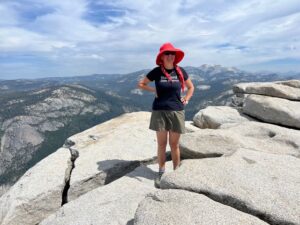
Chiara Sabatti in Yosemite
Meet our newest Contributing Editor, Chiara Sabatti. Chiara is Professor of Biomedical Data Science, and of Statistics, at Stanford University. She discovered statistics while studying economics and has spent most of her professional life working with genomics data. Her recent sabbatical has brought home for her with new clarity that it is important from time to time to step back in order to see the bigger picture. She is hoping that these columns will help her continue to do that.
During the past five months, I have learned about software for automatic differentiation; deep learning models for sequence data; a bit of neuroscience; a bit of psychology; and some immunology. I had encountered these subjects through work, felt that it would be good to study them in more detail, and a sabbatical gave me the opportunity to do so. I think my research and teaching going forward will benefit from this additional knowledge, but I already know that the act of learning has given me new energy and joy.
Being on sabbatical, I had more time, but I also felt free to embrace a different mindset. I was not trying to keep up with the field, or acquire the level of familiarity I needed to accomplish some task. My aim wasn’t to identify open problems in order to write a grant proposal or formulate engaging questions for a class. Like Richard Feynman, I was learning for “the pleasure of finding things out,” and that made me very happy.
A sabbatical is a great opportunity, but not open to all of us, and even when it is, not all that frequently. Mine is almost over. As I get ready to re-enter the usual routine, I am planning to reserve a regular chunk of time to learn. It will take some self-discipline and some negotiations, but it is clear to me now that it is a very low-cost way to increase my gratification and my ability to carry out my job well. If we are to be creative innovators, we do need to nurture curiosity. The tensions in the funding environment make it easier to fall into the trap of looking for accountability of each hour—yet, to win in the long game, we need time to expand our horizons. I think it is important that we remind ourselves of this and that we continue to articulate it for the institutions in which we work.
Joy in learning should also be a spark for our trainees. To be sure, the students we encounter have a variety of motivations, and the educational programs we work with have diverse goals. Experiencing the joy of learning, however, is always helpful. It gives an extra, powerful gear. How do we kindle this joy? The catalyst might be different for each student, but one tool we have as educators is to communicate our own love for the subject and for learning. I am grateful to the multiple teachers who modeled this joy, inviting me to experience it myself.
My undergraduate advisor, Eugenio Regazzini, was especially effective in showing that probability, statistics, and learning were meaningful to him, and a source of joy, aside from his professional obligations. This transpired, for example, from the intelligent creativity of his syllabi, his handwritten course notes, the serious elegance of his attire, and his attentive composure during lectures.
An anecdote is perhaps useful to paint a picture for those who do not know Eugenio personally. The first class I took with him, in fall 1989, was an unregistered seminar: he would lecture for a couple of hours a week, to an open audience, to make sure we had the “right basis” for the “real” class he would teach in the second semester. There were no exams, no grades, no course completion certificate, and no instructor evaluations. The circumstances were privileged: our school had a room to spare; his professional and personal situation were such that he could afford to teach an extra class for free; and we could afford to attend—being full-time students unencumbered by other responsibilities. But this does not detract from the joyful gratuity that those lectures were motivated by and that they inspired.
There is some research that suggests that joy might not be a casual side effect of learning, but a built-in biological incentive that evolved to drive exploration and adaptation: knowledge is power, and our body alerts us to it. And the arts are full of references that underscore the pleasures of acquiring knowledge. In The Sword in the Stone, for example, Merlin suggests:
“The best thing for being sad […] is to learn something. […] That is the only thing which the mind can never exhaust, never alienate, never be tortured by, never fear or distrust, and never dream of regretting.”
I think it is important for us all to remember this as we adapt to a world where artificial intelligence is increasingly competent.
The number of things/skills we need to learn to carry out our functions might decrease (although to which extent is open for debate). However, the pleasure we get from learning isn’t likely to diminish. And since AI tools can be very effective and accessible learning resources, it becomes easier and less costly for us to pursue this source of gratification. So, let’s all reserve time to learn—and let us proclaim that it is fun!