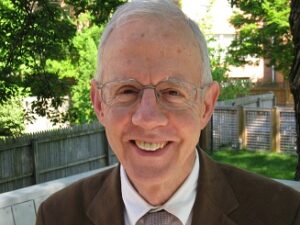
David F. Findley
David F. Findley passed away in June 2025 of complications from Alzheimer’s disease. David was born in Washington DC on December 27, 1940. He earned a BS (1962) and MA (1963) in mathematics from the University of Cincinnati. He then lived in Germany, studying functional analysis under Gottfried Köthe, obtaining a PhD from the University of Frankfurt in 1967. Returning to the United States, he served as a mathematics professor at the University of Cincinnati until 1975. Having transitioned from pure mathematics to statistical time series analysis, Findley took a new academic position at the University of Tulsa, during which time he interacted frequently with the nearby research laboratories of major oil companies.
Findley arrived at the US Census Bureau in 1980 to lead development of a time series staff in the statistical research division and improve seasonal adjustment methodology. He retired from the Census Bureau in 2009, though he continued to consult with the time series staff until 2015.
The widely used X-11 program for seasonal adjustment was released in 1965 by Julius Shiskin and his Census Bureau colleagues, but further development of seasonal adjustment methods at the bureau ceased with their departure in the mid-1960s. Hence, by the late 1970s, there was motivation to restart research and development of seasonal adjustment methods and Findley was hired to lead this effort.
In an early step, the Census Bureau moved from using the X-11 program to using Statistics Canada’s X-11-ARIMA program for production work. There were shortcomings to the time series modeling module in X-11-ARIMA, however, so research and programming work was needed to develop software with new modeling capabilities that included using regression models with ARIMA errors and doing automatic outlier identification.
Findley’s leadership of the time series staff resulted in the development of the X-12 program, released in 1992, which enhanced X-11 with the new time series modeling capabilities and seasonal adjustment diagnostics. X-12 was adopted for seasonal adjustment production by the ECON divisions at the Bureau and other statistical agencies in the US and abroad.
Later development of X-13 (released in 2012) combined X-12 with the SEATS model-based seasonal adjustment software from the Bank of Spain. Adoption of the new software was facilitated by relationships Findley cultivated over the years with those working on seasonal adjustment at other US statistical agencies, including the Bureau of Labor Statistics, Bureau of Economic Analysis, Federal Reserve Board, and Energy Information Administration, as well as with seasonal adjustment researchers and practitioners in Canada, Europe, Australia, New Zealand, and Japan.
In addition to supervising these activities, Findley carried out important research on model selection criteria, particularly on the properties of the AIC criterion proposed by Hirotugu Akaike. This led to collaborations with researchers at the Institute of Statistical Mathematics in Tokyo (of which Akaike was then the director) and academics in the US and other countries.
Findley also produced research in graphical model selection using forecast histories, model selection for non-nested models, and properties of time-domain filters. In pursuing his research, he had stints as a visiting researcher at Academia Sinica (Taipei, Taiwan, three times), Victoria University (Wellington, New Zealand), the University of Lancaster (UK), the Institute of Statistical Mathematics (Tokyo, Japan), the University of Wisconsin, and the University of Heidelberg (Germany). Findley produced more than 40 peer-reviewed journal articles and book chapters, as well as a large number of technical papers.
Over his career, Findley was active in the statistical community. He served as chair, program chair, and secretary-treasurer of the Business and Economics Statistics Section of the American Statistical Association, and associate editor of the Annals of Statistics from 1983 to 1992. He also received the following significant honors and awards: ASA Fellow; Julius Shiskin Award; and the Department of Commerce Gold Medal. He was also the Morris Hansen Lecturer and gave a talk titled “Diagnostics for Modeling and Adjustment of Seasonal Data.” The ASA Fellow award in particular confirmed for Findley that he had successfully established himself as a statistician and time series analyst.
Findley is survived by his wife of 59 years, Mary Findley, who resides in Washington, DC.
—
Written by William Bell, Brian Monsell, and Tucker McElroy
Slightly edited from the version printed in November 2025 Amstat News, and incorporating elements of “A Conversation with David Findley” by Tucker S. McElroy and Scott H. Holan in Statistical Science, 2012, 27(4), pp594–606, DOI: 10.1214/12-STS388