Harry van Zanten
It is with intense sadness that we announce the passing of Harry van Zanten at the age of 52. For the last few years, he coped with a cancer that sadly turned out to be untreatable. He leaves behind his wife Carolien and two sons Hero and Midas, family and many friends.
Harry was born on November 15, 1972, in Hoogeveen in the Netherlands, and attended high school in Barneveld. Becoming a mathematician was not an obvious career path. His PhD, supervised by Peter Spreij and Kacha Dhzaparidze at the University of Amsterdam in 2001, was on Martingales and Diffusions, Limit Theory and Statistical Inference, a title that well expresses his interest in probability and its applications in statistics. He later would say that he liked statistics, as long as (or especially if) it had some martingales or stochastic processes in it.
After completing his PhD, Harry at first chose not to pursue an ordinary academic career and joined Nyfer, an institute for applied economic research. He described his work there as performing linear regression of various types, all focused on proving the correctness of some idea of the director of the institute. Financial mathematics—in the form of option pricing theory and risk management—was becoming fashionable at the Amsterdam universities, for both teaching and research. Given Harry’s love of martingales, it was not too difficult to lure him back into academia. He started as an assistant professor at Vrije Universiteit Amsterdam and proceeded rapidly through the academic ranks, becoming full professor at TU Eindhoven in 2009, only eight years after his PhD. Subsequently he changed university, first to the University of Amsterdam, and then back to the Vrije Universiteit Amsterdam. While practical considerations were important (since his undergraduate days he never really left Amsterdam), his moves also reveal some restlessness, doubts about the value of an academic career or discomfort with university bureaucracy. Still, it came as a big surprise when he announced five years ago that he would step down from his professorship, keeping it for only one day a week to work with students. This was before his diagnosis changed everything; he didn’t have a specific plan of what to do next. Something in consulting, he would answer.
In 2010, he was honoured with the Van Dantzig prize as the most promising researcher in statistics and operations research in the Netherlands under the age of 40. While walking a very fast career path, he received the Veni, Vidi and Vici grants for exceptional talent from the Netherlands Organisation for Scientific Research, as well as smaller awards. He was an IMS fellow.
Harry’s most acclaimed research was on the rigorous, mathematical understanding of Bayesian methods. He derived guarantees but also exposed limitations, for the accuracy of nonparametric methods judged from the non-Bayesian (“frequentist–Bayes”) point of view. One derives a posterior distribution fully within the Bayesian paradigm but then studies its properties under the assumption that the data is in reality generated according to a fixed distribution. Does the posterior distribution contract to this distribution? How fast if the data becomes more informative? Does the spread in the posterior distribution give a realistic quantification of the statistical uncertainty? Are there computational shortcuts with similar accuracy? One of his most acclaimed findings was to relate the small ball probability of a Gaussian process when used as a prior for a regression or log density function (a popular practice in machine learning) to the posterior contraction rate. The type of process matters a lot.
Besides Bayesian statistics, Harry published on topics in probability, such as series expansions of fractional Brownian motion, martingale inequalities and central limit theorems.
Harry served the community in various ways, perhaps his biggest involvement being the organization of the Bayesian Nonparametric Meeting (2014) and the European Meeting of Statisticians (2015), both in Amsterdam. We fondly remember him as one of the initiators of the Amsterdam Bayes Club (and later the Thematic Seminar), which brought together researchers in Amsterdam in the ten years surrounding 2010. Meetings were often concluded in the pub and gathered a crowd of faculty and PhD students. It was a fruitful and fun time for statistics in the Netherlands.
Harry was a dedicated and generous mentor. He supervised 13 PhD students and several postdocs. He cared deeply about the wellbeing of his students, also outside of work, and was very approachable.
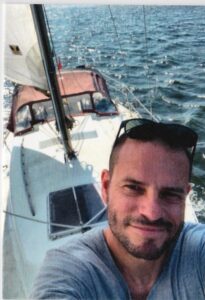
Beyond academic life, Harry loved to sail. He co-owned a sailboat, renovating it over winter, making trips during the summer with friends and family, in particular his brother, as far as the North Sea or the Mediterranean. He will be missed, by both younger and older colleagues.
—
Written by Botond Szabó and Aad van der Vaart