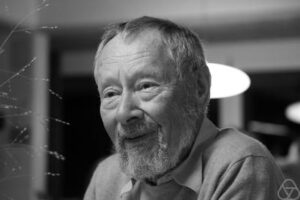
Klaus Krickeberg at a meeting of the Oberwolfach Committees in 2016. Photo: Gerd Fischer/MFO
On November 27, 2025, the distinguished mathematician and outstanding teacher Klaus Krickeberg passed away at the age of 96. His broad scientific interests concerned the fields of analysis, martingales, stochastic geometry and point processes, and moreover, epidemiology and public health. To him, mathematics was a reflection of reality, in which he developed gradually from the abstract to the concrete. Geometrical insight is visible in all his work.
Born in 1929 in Ludwigslust, Germany, Krickeberg grew up in a medically oriented family. His father was a radiologist and his mother a medical technical assistant. His intelligence became evident early on. After only three years of primary school, he entered the Collège Français in Berlin, a secondary school founded in 1689 for children of Huguenot refugees, among them his maternal ancestors.
Krickeberg completed his secondary education in 1946 and began university studies in autumn. The lectures of Erhard Schmidt impressed him deeply; later he described them as “the most wonderful lectures I ever heard, delivered entirely from memory.” Completing his studies in 1951, he earned his doctorate at 23, and 1954 he completed his Habilitation in Würzburg. By the age of 29, he had become one of the youngest professors of his time: from 1958–71 at Heidelberg; 1971–75 at Bielefeld; and 1975–98 at Paris Descartes (Paris V) University.
His scientific work comprises, in this first mathematical period, the following fundamental contributions: convergence of martingales with a directed index set; distributions in the sense of Laurent Schwartz; functions of bounded variation and Lebesgue surface measure of a non-parametric surface; strong mixing properties of Markov chains with infinite invariant measure; invariance properties of the correlation measure of line processes; and moments of point processes.
Krickeberg’s mathematical teaching reached a wide audience by means of three books, but also by locally published surveys and notes, written for his lectures in Chile, Cuba, Poland or Vietnam—and always in the local language. These have been particularly influential, each of them recasting complicated and unarranged material in an accessible and elegant form, thereby setting clear lines for future research.
From 1971 to 1985 he was chief editor of the Journal of Probability and Related Fields. In 1992 he initiated the book series Statistics for Biology and Health.
In 1974 he travelled by train to Vietnam to teach mathematics in Hanoi. After that, Klaus returned year after year to support Vietnamese scientists. Over time, his commitment expanded beyond mathematics. In the final decades of his life, improving healthcare and health education in Vietnam became a central focus. He worked to strengthen epidemiological teaching, co-authored books with Vietnamese colleagues, gave lectures, and organized workshops.
Klaus Krickeberg became a Fellow of the Institute of Mathematical Statistics in 1968. He was elected into the International Statistical Institute (ISI) in 1971, was a member of its Council from 1985–89, and chaired its committee for the development of statistics in developing countries from 1987–91. He was President of the Bernoulli Society in 1977–79. He initiated the establishment of the Latin America Regional Committee (LARC), and the East Asian and Pacific Regional Committee (EAPRC), and chaired the program committee of the first Bernoulli World Congress in Tashkent in 1986. (In Bernoulli News, 29(2), pp9–10, he tells anecdotes about this congress.)
In 1983 he was elected to the German National Academy of Sciences, Leopoldina. Klaus Krickeberg received an honorary doctorate from the Faculty of Social and Economic Sciences at the University of Vienna in 1990. He was elected as a Fellow of The World Academy of Sciences (TWAS) for the advancement of science in developing countries in 1994.
He received several distinctions for his activities in Vietnam. In 2009, it was the Medal of the Ministry of Health for Contributions to the Health of the Population. Then, in 2011 the National University of Science of Ho Chi Minh City bestowed on him its Honorary Doctorate for his work in mathematics, and in 2015 the Thai Binh University of Medicine and Pharmacy made him an Honorary Professor.
For his 90th birthday in 2019, he received the Friendship Order, the highest order bestowed by the Vietnamese government on foreign individuals by the President of Vietnam for “many positive essential contributions to the development of the Vietnamese health sector” (Bernoulli News, 26(1), p5).
—
Written by Klaus Dietz (University of Tübingen, Germany) and Hans Zessin (University of Bielefeld, Germany)