Marianne Huebner, our newest contributing editor, is Professor of Statistics and Probability, Adjunct Professor of Kinesiology, and Director of the Center for Statistical Training and Consulting (CSTAT), at Michigan State University. She is also a competitive weightlifter, lifting in national and international championships. She seized a chance to combine these passions:
By chance, a few years ago, I crossed paths with a weightlifting coach at a gym I attended. He put me through my paces to test my mobility, technical skills, muscle power—all with a plastic pipe. I wasn’t good at any of this, but I was hooked.
Fast forward a couple of months and I registered for my first weightlifting competition. The registration form said that medals would be awarded according to “the formula”… which caught my attention. It turned out this formula referred to scaling the total weight lifted—the sum of the best snatch* and the best clean & jerk** (of three attempts each)—so lifters of different body mass could be compared. Since heavier lifters typically lift more weight than lighter ones, a body mass adjustment is needed to rank competitors, regardless of whether they weigh 50 kilograms (110 pounds) or 150 kilos (330 pounds). The adjustment was based on a logarithmic model fitted to world records for eight distinct body mass categories, calculated separately for men and women. The resulting body mass coefficients were then applied universally, regardless of age or level. In addition, the competition’s formula also considered age. Since weightlifting performance declines with age, the resulting scaled total was then multiplied by age coefficients for older athletes (“Masters,” i.e. over 35s). These age coefficients were derived from decades of World Masters Championship results—but only those achieved by men. That struck me as problematic: body mass adjustment based on world records, and age coefficients based solely on men’s performances. Clearly, something needed to change.
When I raised this issue, the argument was that women’s participation was growing rapidly [1] and their performances had not stabilized, so age coefficients would not be “realistic”. But my analysis showed a cohort effect with less change in recent years. Using quantile regression models, we created age coefficients for women. Women weightlifters loved it. Women’s age coefficients revealed a different pattern: they were similar to those of men at younger ages but showed a more rapid decline at around 45 years of age, typical in sports requiring muscle power. These age coefficients have been used in national and international competitions.
I assumed that would be my only contribution to statistics in the sport of weightlifting. But as I continued to train, questions continued to arise. Weightlifting requires speed, power, technical and mental skills, and strength. Sadly, muscle power declines faster than muscle strength, but muscle power is often a better indicator of physical function and preventing falls [2]. This led me to wonder: how do older weightlifters—whether they are in their 30s, 50s, or 70s—train? How does balance, strength, and muscle power change with age? I learned that, compared to community-dwelling, healthy adults, weightlifters defy aging.
I had avoided investigating the question of scaling the total with respect to body mass. Historically, researchers proposed various functional forms, often restricted to subsets of athletes (limiting the body mass range, or males only) or subsets of performances (world records or podium places). Nations may use such systems to select a weightlifting team for the Olympic Games. Later, I was asked about helping to develop a new scaling method due to the shortcomings of existing models. With collaborators we worked on quantile foliation [3], fractional polynomials, and most recently generalized additive models with splines. The latter enabled us to create a unified scaling system suitable for ranking mixed teams, of men and women [4]. With this method we can compare athletes across body mass and sex. Model residuals make it possible.
Nearly 10 years have passed since my first weightlifting competition. Since then, I have won several World Masters Championships, set new world records in my age group, and published multiple papers related to weightlifting. The weightlifting community is extraordinary. I am continually inspired by the grit and determination of lifters who train despite challenges. Through this journey, I have learned that it’s never too late to start weightlifting and enjoy its benefits. Best of all, I can combine it with my passion for statistics in order to make meaningful contributions.
—
* In the snatch, the weight is lifted from the floor to overhead in one continuous movement.
** The clean and jerk is a two-part movement, where the weight is first lifted to the shoulders and then thrust overhead.
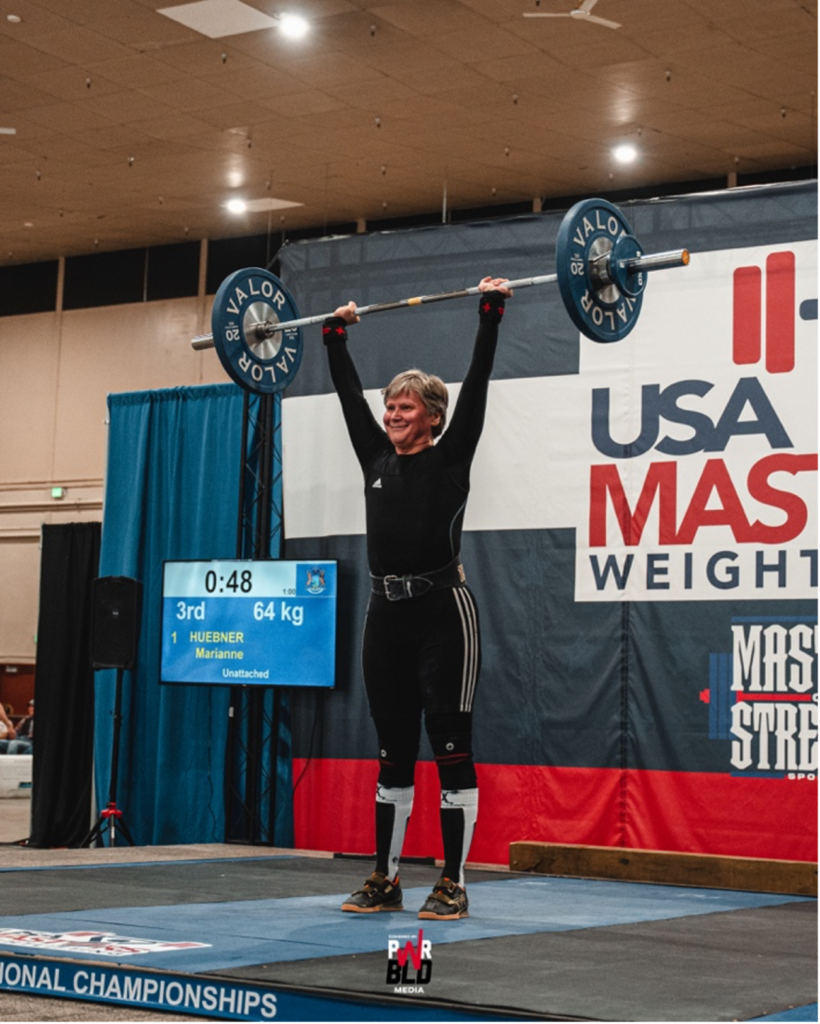
Marianne Huebner at the March 2025 USA Masters National Weightlifting Championships
References:
[1] Huebner, M., Meltzer, D.E., Perperoglou, A. Strength in Numbers Women in Olympic-Style Weightlifting, Significance 2021 Apr; 18(2).
[2] Lo, O., Kahya, M., Manor, B. Powering Through Daily Activities in Older Age—Will Power Training Replace Strength Training in Later Life? JAMA Network Open. 2022; 5(5): e2211631, doi:10.1001/jamanetworkopen.2022.11631
[3] Perperoglou, A., and Huebner, M. Quantile foliation for modelling performance across body mass and age in Olympic weightlifting. Statistical Modelling 2021; 21 (6), 546–563, doi:10.1177/1471082X20940156
[4] Huebner, M., and Cole, T.J. Ranking performances of Olympic-style weightlifters adjusted for body mass on the same scale for both sexes: A novel approach. J. Sports Sci. 2024 Nov; 42(22):2124–2130 doi:10.1080/02640414.2024.2423138