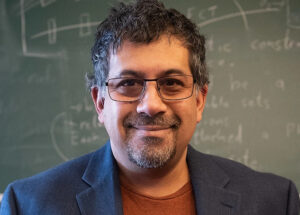
Sayan Mukherjee. Photo: Humboldt Foundation/elbmotion
On March 31st of this year, our community lost the energetic and creative force that was Sayan Mukherjee. Sayan passed away unexpectedly at the age of 54 in Leipzig, Germany, where he was a Humboldt Professor at the University of Leipzig and a Fellow at the Max Planck Institute for Mathematics in the Sciences after spending 18 years at Duke University.
Sayan loved translating between ideas from different fields and working on a wide range of topics, including Machine Learning, Bayesian models, computational biology, cancer genomics, human evolution, statistical modeling of shapes, inverse problems for chaotic dynamics, topological data analysis, foundations of probabilistic inference, and the application of homology and sheaf theory to statistics and Markov chains.
Some of his well-known works include the paper that established Gene Set Enrichment Analysis, works on the statistics of persistence diagrams, which are central to Topological Data Analysis, papers on statistical models of shape space, papers on stability in learning theory, works on the use and theory of support vector machines, works using statistical models to analyze the microbiome, and a paper using fast PCA methods to study the co-evolution of genes.
Born March 8, 1971, in Kolkata, India, Sayan lived in France, England and Canada before moving to the United States in grade school, where he stayed until he moved to Leipzig in 2022. His academic trajectory mirrored his diverse interests. He obtained an undergraduate degree in Electrical Engineering from Princeton University in 1992, a Master’s in Applied Physics and Mathematics from Columbia University in 1996, and a PhD in Brain and Cognitive Sciences from MIT, under the direction of Tomaso Poggio, in 2001. Between Princeton and MIT, he worked at Los Alamos National Labs. After MIT, he was a Sloan Postdoctoral Fellow in Computational Molecular Biology at the Broad Institute. In 2002, he joined the Computational Biology and Biostatistics Department in the Duke Medical School as an assistant professor. Over time, his appointment evolved to one in the Duke Statistical Science Department and then jointly between Statistics and Mathematics, all while maintaining numerous affiliations across the university and its medical school, including the Computational Biology and Bioinformatics programs and Computer Science. He received the Young Researcher Award from the International Indian Statistical Association and was a Fellow of the Institute of Mathematical Statistics. He was promoted to Full Professor at Duke in 2015.
Sayan loved listening to and playing music. He loved eating and cooking, and talking about eating and cooking. He loved cooking for others and hosted many dinner parties featuring his latest culinary experiments. He loved to think about the philosophical aspects of the topics he studied. He was a dedicated and empathetic mentor, working with students and postdocs from across the university and around the world. He loved exposing his students to new ideas and watching them find their way in science and life. He always tried to be there for individuals going through a rough patch. But above all, he loved being a father to his son, Kiran.
His infectious spark and love and support for those around him will be missed, as will all of his t-shirts, some of which were in good taste.
To leave and read remembrances, visit https://sayan-mukherjee-memorial.github.io/
Additional information can be found in the following articles:
https://math.duke.edu/news/duke-mourns-death-statistician-and-mathematician-sayan-mukherjee
https://cbmm.mit.edu/news-events/news/memory-sayan-mukherjee
and
https://idw-online.de/en/news850088.
—
Written by Jonathan Mattingly, Kimberly J. Jenkins Distinguished University Professor of New Technologies, Duke University, USA