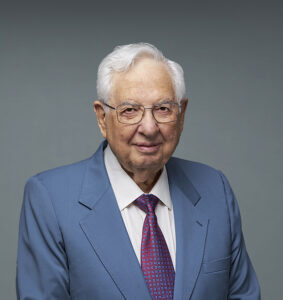
Eugene (Gene) Laska
It is with heavy hearts that we share the news of the passing of Eugene M. Laska, PhD. Gene Laska was Research Professor of Psychiatry and Population Health, Division of Biostatistics, at New York University. Before moving full time to NYU in 2015 he served as Research Scientist and Director at the Nathan Klein Institute Collaborating WHO Center for Mental Health Research.
Dr. Laska was an internationally renowned applied mathematician and statistician, a leading consultant to the FDA on the design and analysis of psychopharmacology trials, and a pioneer in the application of artificial intelligence and machine learning to advance precision medicine in psychiatric disorders. Above all he was a wonderful friend and beloved mentor, profoundly shaping the careers of several generations of clinical researchers.
Dr. Laska received his PhD in Mathematics from the Courant Institute at NYU and completed a Postdoctoral Fellowship in the Department of Statistics at Stanford University. Early in his career, he worked as a Systems Engineer at IBM before directing the Information Sciences Division at the NYU affiliate Nathan Klein Institute. Next, he served as Director of the Statistical Sciences and Epidemiology Division at Nathan Klein. Dr. Laska joined the NYU Langone faculty as Adjunct Assistant Professor of Mathematics in 1961, and was promoted to Research Professor in 1979.
Throughout his distinguished career, Dr. Laska has made extraordinary contributions to statistical analysis and computational modeling in our field. In the 1970s he developed one of the world’s first electronic medical record systems. He was a pioneer in early machine learning and decision support systems for the selection of psychiatric medications. He lobbied for better funding for homeless people, creating a method for counting the unknown number of persons living homeless in the New York City area in the 1990s. He led the analytic work on a large international study conducted by the WHO comparing the incidence and course of schizophrenia worldwide. More recently his work focused on artificial intelligence and machine learning to advance precision medicine by diagnostic subtyping and biomarker prediction of treatments for alcohol use disorder and PTSD.
Dr. Laska had the character and vibrancy of a renaissance man. As a remarkable testament to his energy, vitality, and creativity, at the age of 85, Dr. Laska was awarded a National Institute on Alcohol Abuse and Alcoholism R01 research grant as principal investigator, to identify likely responders to treatments for alcohol use disorder.
His hobbies included boating, painting, and building guitars. His mind was a mile wide and a mile deep. Many of us had hours of pleasure discussing art, culture, history, politics, sports, the beauty of mathematics, and especially, the joys of family.
Dr. Laska was first and foremost family man and a humanist. As a mentor, he understood that learning is not transactional, it takes place in the context of a relationship. His extraordinary career did not get in the way of his love for his family and his caring and warmth for his friends, mentees and colleagues. We acknowledge and share our deepest condolences with the Laska family.
—
Written by Charles R. Marmar, MD (Peter H. Schub Professor and Chair, Department of Psychiatry, NYU Langone, and Director of the Center for Precision Medicine in Alcohol Use Disorder and PTSD); Lorna E. Thorpe, MPH, PhD (Anita and Joseph Steckler Professor and Chair, Department of Population Health, NYU Langone); and Donald C. Goff, MD (Marvin Stern Professor and Vice Chair for Research, Department of Psychiatry, NYU Langone, and
Director of the Nathan Kline Institute).